No Space to Speak, Pray, or Protest: The Expanding Censorship Regime in Kashmir
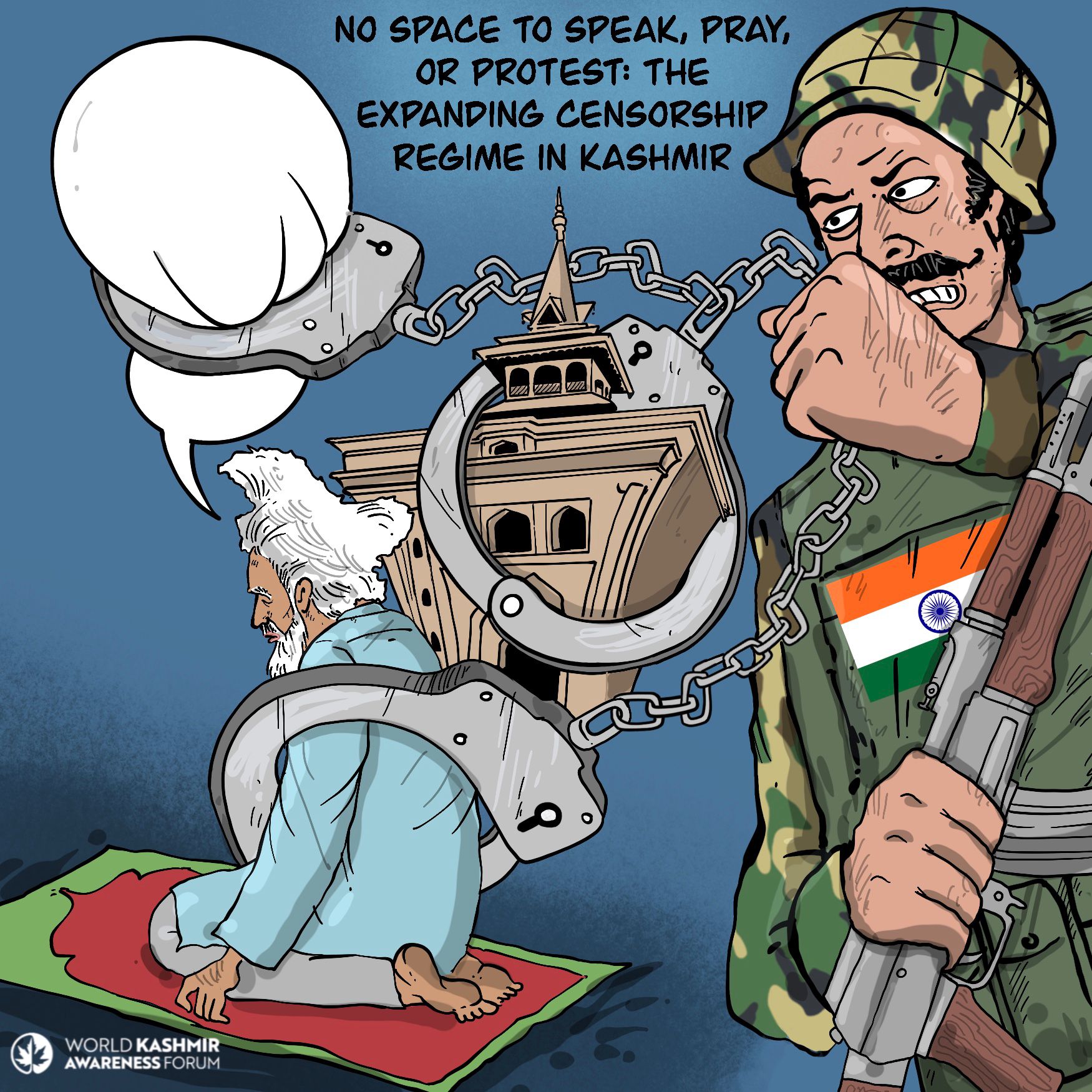
The recent shutting down of the historic Jamia Masjid on March 13, the last Friday of Ramadan (Jumat-ul-Vida) marks yet another event in the ongoing struggle faced by the Muslims of Indian-occupied Kashmir. To the indigenous people of Indian-occupied Kashmir it is much more than that; it represents a trend of fundamental rights being curtailed.
It was on a day of great spiritual significance that the mosque was closed and thousands were not allowed to pray there. This was not merely a closed building to Kashmiris, but a signal that they do not have the right to meet and pray together.
Jamia Masjid has always been a place of worship in many ways. It has been used in the past as a social gathering point, a contemplation spot and even just a peaceful escape. Forcefully closing it on such an occasion sends an emphatic message on the evolving reality in Kashmir that even ordinary religious activities are covered by fear and insecurity according to many inhabitants. The extensive roadblocks and arbitrary curfews by Indian troops tend to render individuals unable to leave their residences, not mentioning the inability to make it to the central mosques.
Rampant reports amongst locals of brutal treatment during such restrictions have ranged from aggressive crowd control to the use of violence against civilians who dare to meet for prayers.. In other cases, fights instigated by the occupational forces have been reported which led to the injuries of Kashmiri worshippers..
These incidents make it so that the majority of Kashmiris have a firm belief that the Indian forces are not simply limiting movement but are employing intimidation and physical force against ordinary Muslims especially during the religious month. Whether at protests or prayers, citizens live in fear of being stopped, interrogated or tortured.
This restriction and fear shapes the daily life of Kashmiri people. This shutdown of Jamia Masjid, therefore, is not just a one-off incident, but it is a metaphor of a larger phenomenon in which space to live, to talk and to practice religion is gradually shrinking at the hands of the Indian state.
This case is a manifestation of a larger trend. Speaking, gathering, creating and even praying are being restricted at an increasing rate in Kashmir.
No Space to Protest or Speak Freely
Previously, the residents of the Indian-occupied Kashmir would go to the streets to express themselves and air their grievances. Nowadays, it has become very hard.
Mass meetings are regularly limited and individuals are even preemptively detained in case they make attempts to organize protests. The streets are also highly patrolled by heavily armed Indian troops and even small groups can be detained. A large number of individuals have preferred to remain silent today, not because they are content with what is going on, but because it might lead to severe repercussions.
Political leaders and activists are routinely detained prior to organizing events. This renders unity among the people almost impossible as they cannot even raise their voices in a peaceful manner. Due to this fact, the silence that appears in Kashmir today must not be confused with peace. It is a silence shaped by fear.
Restrictions on Religious Life
The Jamia Masjid closure raises a bigger concern, which is restriction on religious liberty. Friday prayers play a very crucial role in Islam and in Muslim-majority Kashmir, the Masjid has always been a gathering place where people gather in huge numbers. But these meetings are often limited especially during tense moments.
It is frequently reported that Indian forces are forcefully closing mosques, blocking roads, and preventing people from going to the prayers. In certain regions, individuals do not dare move out because they are afraid of being questioned or harassed.
This is a torture to Kashmiris. The fact that they cannot pray on their own, particularly on such significant days as Ramadan, makes them feel that they are being attacked directly on their religion. The mosques of Kashmir are not only the places of worship-they are the community spaces. When they are not readily available, it has a serious impact on spiritual and social ties in the community.
Culture Under Pressure
The culture of story telling, poetry, and art is rich in Kashmir. These forms have been utilized over the years by people to share their emotions, the struggles that they face, and their expectations. Even cultural expression is being curtailed today.
Books discussing the reality of Kashmir have been banned or heavily censored.. There have been checks and pressure towards bookstores, and writers feel that they should avoid writing about sensitive topics. This leaves one in a position of being fearful of writing or expressing themselves.
Documentaries and films are not an exception. Narratives that do not coincide with the official one are banned. Filmmakers will struggle to publish their work or find their target audiences. This has an impact on the perception of Kashmir not only by the outside world but also by the people themselves.
Media Facing Pressure
In Indian occupied Kashmir, journalism is now a challenging and a risky task. Journalists who attempt to report the reality on the ground are prone to pressure. Newspapers and media houses are not always free to operate. Financial stress and constraints and legal harassment are contributory factors. Certain journalists have been interrogated or even arbitrarily detained for long periods of time because of their work.
The Human Rights Watch and Amnesty International are groups that have expressed concerns regarding the treatment of journalists in Kashmir. Due to such an atmosphere, a good number of reporters are compelled to be cautious. Some narratives are not reported and some are not heard. To the populace, it translates to having few insights into the entire picture of what is going on in their own homeland.
Digital Spaces Are Also Controlled
The internet has become one of the primary communication methods of people in the modern world. In Kashmir, this space is not even entirely free. Internet censorship and shutdowns at the hands of the occupation have occurred with regularity, isolating individuals among themselves and to the outside world. This communication breakdown not only affects students, businesses, but families as well.
People are under surveillance even when the internet is available. Posts on social media can be problematic, thus most users do not express themselves. ProminentKashmiri voices, particularly in the diaspora have also complained about the lack of visibility of their content online. India has frequently geoblocked accounts that challenge their narrative of Kashmir. Their voices are being muted into submission.
The limitation of tools such as the VPN becomes a way of hindering the freedom of access to information. All of this contributes to the impression that even online environments are not a place where one can feel safe to express.
A Life of Constant Limits
Life in Kashmir is not defined by just one form of restraint. It is numerous prohibitions united. People cannot gather freely. They cannot pray without a shiver. They find it difficult to express themselves through art or writing. Journalists face significant pressure and online spaces are controlled.
The result of this is that Kashmiris are ever cautious, they think before they talk, before they do, or even before they simply post online. This has fundamentally shifted the functioning of Kashmiri society. It is not simply a matter of laws or politics, but a matter of everyday life being tightly controlled.
The Human Impact
Common people are the ones who are affected the most by all this. It is a stressful life that has an impact on the mind. Fear and uncertainty enter into everyday life. Individuals do not speak frankly even to friends or families. Community life also suffers. The inability of people to meet in mosques, in the streets, or online undermines contacts and creates isolation.
To the youth who are brought up in such a setting, the impacts are even more profound. They are taught early enough that freedom of speech can be dangerous. This predetermines their worldview and their role in the world.
Conclusion: A Silence That Speaks Volumes
The closure of Jamia Masjid during Ramadan is not a one-off event. It is representative of a wider problem in Kashmir.
To Kashmiris, Indian troops are not ensuring that things are in order; they are a force that dictates movement, restrains expression and instills fear among the common citizens. The descriptions of limitations, checkpoints, and pressure on even basic actions such as attending prayers add to this perception.
When individuals are unable to speak and assemble in tranquility, profess their religion freely, and share their narrations, the effects are even more profound than politics. It touches every part of life.
The silence in Kashmir today does come from nothing. It bears the burden of unsung voices, untold narratives and highly restricted lives. And with that probably the most significant question is: what happens to a people when not even their silence belongs to them?