DIGITAL CENSORSHIP
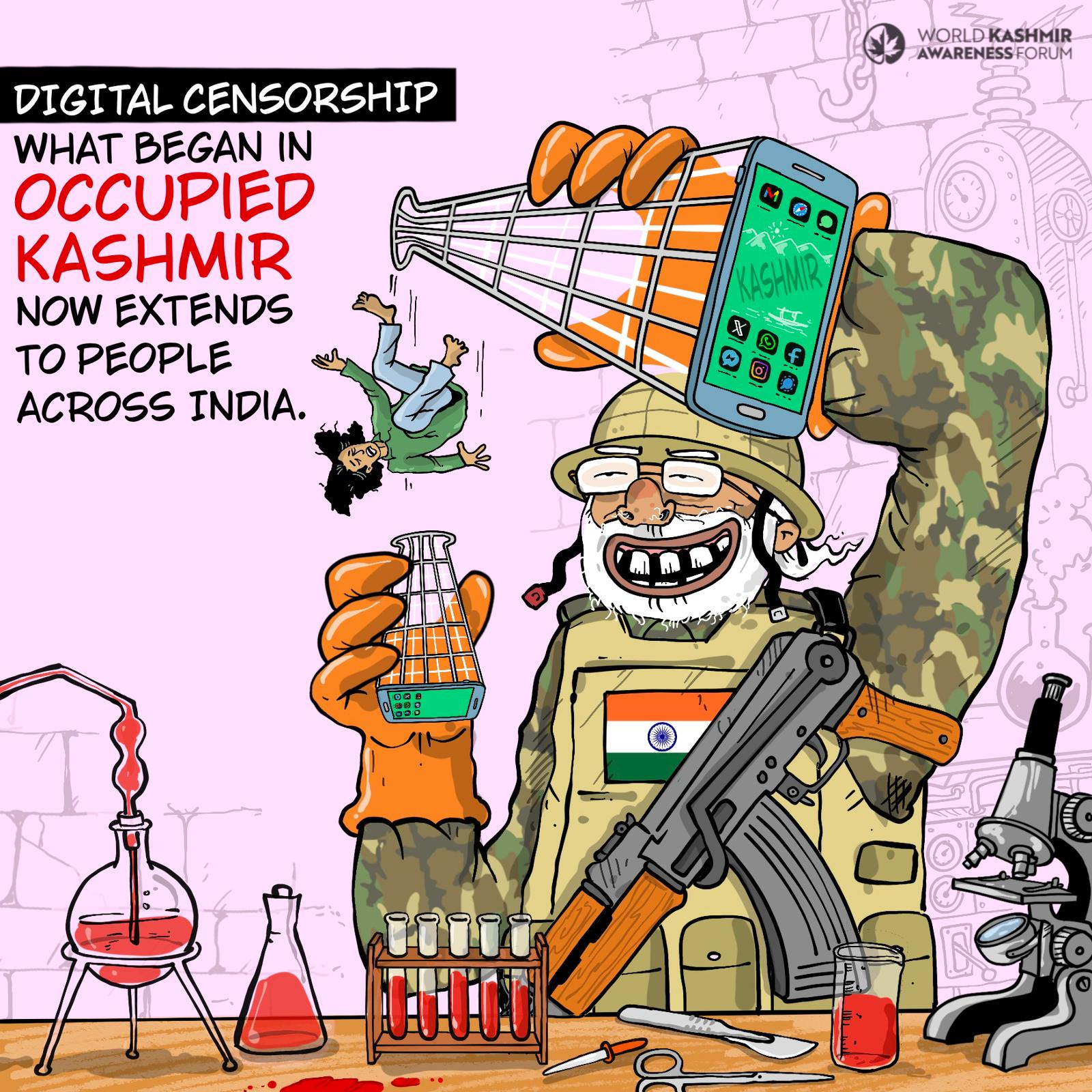
What began in occupied Kashmir now extends to people across India
In the rugged geography of the Himalayas, silence has been weaponized for decades. What the world once viewed as an emergency measure in occupied Kashmir has, in reality, been the blueprint for a much larger, more insidious project of erasure. Today, the digital walls that were first erected to suffocate Kashmiri voices are being extended across the Indian landscape. The laboratory of repression has exported its primary product: total narrative control.
The Laboratory of the Blackout: A History of Silence
For Kashmiris, the internet is not a luxury or a simple utility; it is a site of constant struggle. The history of digital control in the region is a history of deliberate, clinical blackouts. Communication itself has never been treated as a right in Kashmir. Even basic telephony arrived late and under heavy surveillance, and mobile networks were introduced years after becoming commonplace elsewhere, only after prolonged state hesitation and security “clearances.” The same logic extended to the internet, which was repeatedly restricted, slowed, or denied altogether, long before shutdowns became normalized.
We must look at the timeline to understand the scale of this repression.
In 2019, following the illegal and unilateral abrogation of Article 370, Kashmir was plunged into a total communication blackout that lasted for 223 days, the longest ever recorded in a self-described democracy.
These blackouts were never truly about public safety or preventing unrest. They were about breaking the collective spirit of a people. By cutting off the pulse of digital communication, the Indian state ensured that while they were busy re-engineering the laws and the very demographics of the land, the people remained unable to scream. This was the birth of the infrastructure of silence, a testing ground for how a modern state can make an entire population disappear from the global map without firing a single bullet.
Codifying the Kill Switch: The New IT Laws
The harsh tactics once reserved for the disturbed frontier of Kashmir are now being written into India’s national legal code. The government is pushing through new Information Technology (IT) Rules and digital enforcement laws that are becoming increasingly draconian. These laws effectively give the state a “kill switch” over the digital world.
Under these rules, the government can force social media companies to delete any post, block any account, or identify the originator of a message that challenges the state’s version of “normalcy.” What started in the Valley, where journalists are routinely arrested under the Unlawful Activities (Prevention) Act (UAPA) for simply posting a photograph or a tweet, has now become the standard operating procedure for the ruling Hindu Nationalist regime.
The intent is clear: Total Narrative Hegemony. By owning the digital infrastructure, the state doesn’t just hide the news; it attempts to colonize the truth. They want to ensure that the only version of truth that exists is the one approved by the Prime Minister’s office.
The Architecture of Surveillance
Beyond just shutting down the internet, the Indian state has used Kashmir to perfect the Digital Panopticon, a system where everyone is watched, and everyone knows they are watched. In the valley, community policing has been replaced by digital policing. Social media users are summoned to police stations for likes and shares, and a massive database of digital suspects has been built.
This architecture is now being exported. We see it in the way facial recognition technology is being deployed across Indian cities, and in the way the government tracks the digital footprints of activists, students, and farmers. The Kashmir Model has taught the regime that if you can monitor the digital life of a citizen, you can control their physical life. The fear that has lived in the hearts of Kashmiris for years is now being felt by every dissenter in Delhi, Mumbai, and beyond.
The Saffronization of the Digital Space
We cannot discuss these restrictions without addressing their ideological core. This digital cage is a key part of the Hindutva project. In Kashmir, digital censorship is intrinsically linked to the broader attack on Islam and religious freedom. When the state shuts down the internet during Friday prayers or blocks videos of religious gatherings, it is an act of cultural war.
The ruling Hindu nationalists have framed Muslim identity and Islamic expression as a security threat. This allows them to justify more spying, more blocks, and more arrests. This strategy of criminalizing the faith was perfected in the valley, and it is now being used across India to target Muslim activists and anyone who dares to speak out against the regime’s vision of a Hindu-only nation. By labeling digital dissent as anti-national, the state gives itself the moral excuse to use its most violent tools against its own people.
The Facade of Normalcy
The Indian government loves to use the word “normalcy” when talking about Kashmir. They point to tourists and open shops as proof of peace. But a peace that is maintained through cell phone shutdowns, internet blocks, and the constant threat of the UAPA is not real peace. It is a state of occupation.
The regime’s obsession with the “kill switch” reveals a fundamental truth: their control is fragile. They are terrified of what happens when people speak to each other without a filter. They are terrified of the earth refusing silence. They can occupy the land, and they can keep leaders like Yasin Malik and thousands of young students in prison, but they cannot win the heart of a people who refuse to be silenced.
The Global Cost of Silence
Kashmir is the mirror in which the future of global dissent is being reflected. As India moves its Kashmir Model of censorship into its own cities, the international community can no longer afford to look away. These are not just administrative tweaks or tech regulations. This is a settler-colonial strategy designed to achieve the absolute erasure of indigenous and minority voices.
The silence forced on the valley is now a shadow hanging over the entire subcontinent. But memory is resilient; even in the dark, the pulse of the Kashmiri resistance continues to beat. The truth does not need a high-speed connection to survive; it lives in the stories told in the dark, in the prayers said in secret, and in the refusal of a people to let their identity be deleted.
Breaking the Cage
The digital cage may be getting stronger, but it is also getting more visible. Every time the government shuts down the internet or arrests a journalist for a tweet, they admit that they have lost the argument. They have the technology, they have the laws, and they have the guns, but they do not have the truth.
The world must recognize that the struggle for digital rights in India begins with the liberation of the Kashmiri voice. Until the Kashmir Laboratory is shut down, no one’s digital freedom is safe. The fight for the internet is, at its heart, a fight for the right to exist, to remember, and to resist. And as long as the people of Kashmir continue to stand, the cage can never truly be closed.