
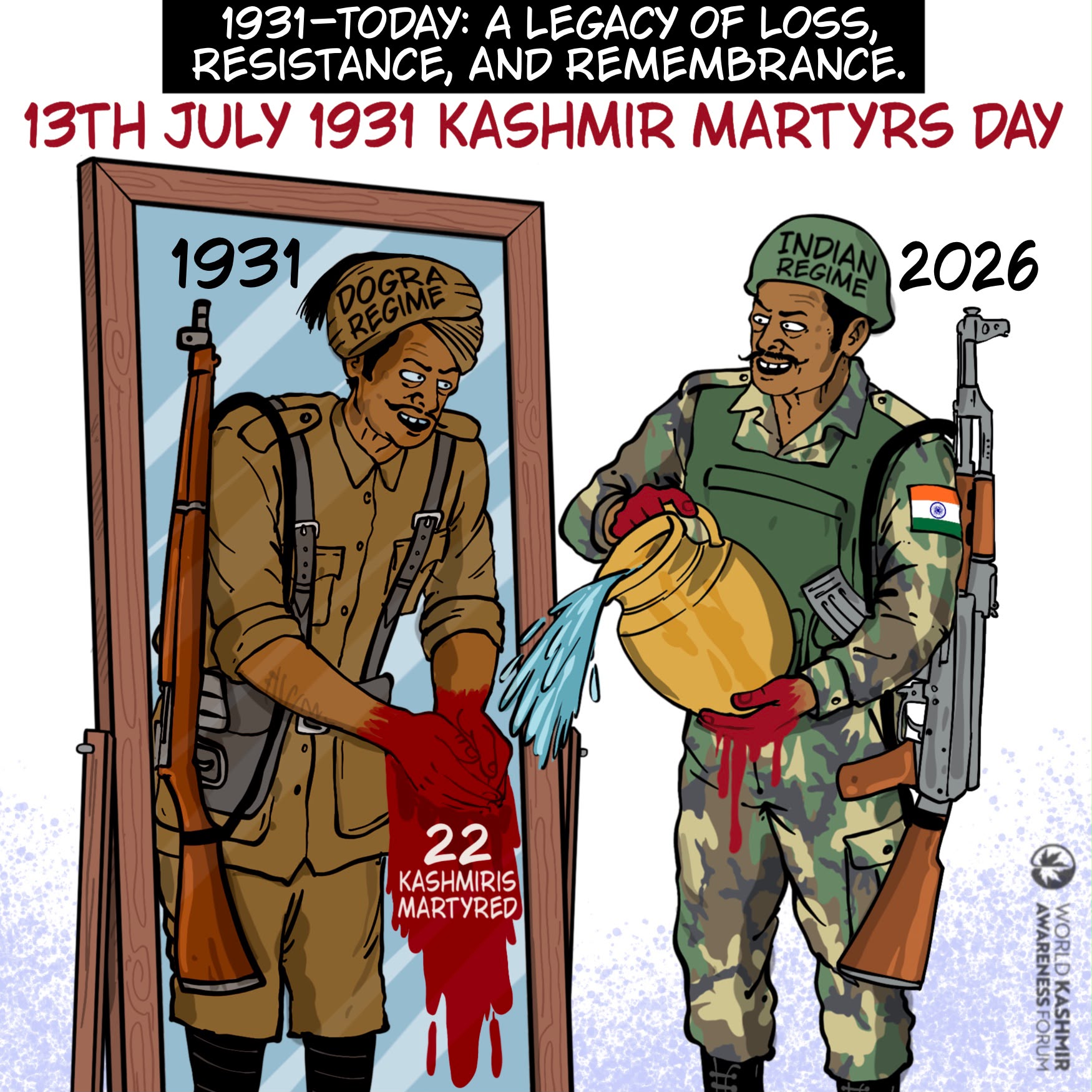
Erasing History, Silencing Memory: Why Kashmir Martyrs’ Day Refuses to Be Deleted
For decades, July 13 stood as a foundational pillar of modern Kashmiri political consciousness. Today, it has become a focal point of intense state suppression, scrubbed from official calendars, sealed behind razor wire, and targeted for complete public deletion. Understanding why the state seeks to erase this specific date, and why Kashmiris refuse to let it fade, exposes the deeper machination of settler-colonial memory control.
The Genesis of July 13, 1931: A Foundation of Resistance
To comprehend the significance of Kashmir Martyrs’ Day, one must look past modern political narratives to the events of July 13, 1931. On that afternoon, thousands of Kashmiris gathered outside Srinagar’s Central Jail during the trial of Abdul Qadeer, an outspoken figure travelling with a European tourist witnessing the terrible plight of Kashmiri Muslims, publicly challenged the oppressive, autocratic rule of the Hindu Dogra monarchy in a public speech.
When time came for the obligatory Zuhr (afternoon) prayer, a young Kashmiri stood up outside the jail premises to deliver the Adhan (the Islamic call to prayer). Before he could finish, Maharaja’s royal guards opened fire, killing him instantly. Undeterred, another Kashmiri stepped forward to continue the call from the exact line where it had been interrupted, only to be shot down as well. This heroic succession continued until twenty-two Kashmiris were killed, one after another, to complete a single call to prayer.
Historians widely regard July 13, 1931, not as an isolated tragedy, but as the moment of Kashmiri political awakening. It was the moment a population, long subjected to severe economic exploitation and religious disenfranchisement, organized a collective demand for civil rights, representation, and human dignity. For over seven decades, July 13 was formally commemorated with an official state holiday, a public ceremonial guard of honor, and annual visits to the Mazar-e-Shuhada (Martyrs’ Graveyard) in Srinagar.
The Architecture of Erasure: Post-2019 Deletion
Following the Indian regime’s unilateral revocation of Jammu and Kashmir’s special constitutional status in August 2019, the official status of July 13 was among the first casualties of the new administrative regime. The state’s strategy to erase July 13 operates across three distinct levels:
1. Legal and Calendar Delisting
The regional public holiday observed continuously since 1948 was officially removed from the government calendar. In its place, state authorities installed alternative dates designed to project a manufactured narrative of seamless integration, while actively stripping official recognition from a day that represents indigenous resistance.
2. Spatial and Physical Blockades
Every year as July 13 approaches, the roads leading to the historic Mazar-e-Shuhada (Martyrs’ Cemetery) in downtown Srinagar are sealed off with armored vehicles, steel barricades, and razor wire. Regional political figures, civil society members, and religious leaders are regularly placed under house arrest or detained to prevent any collective gathering or memorial prayer service at the gravesites.
3. Ideological Revisionism
Beyond physical blockades, the Modi regime has engaged in explicit narrative modification, attempting to delegitimize the 1931 martyrs in public assembly debates and state media. By recasting historical figures who fought for basic civil liberties as “disruptive elements,” the state seeks to strip the event of its moral authority and decolonial significance.
Why Preserving Memory Is an Act of Resistance
The attempt to delete Kashmir Martyrs’ Day is not an isolated exercise in administrative revisionism; it is part of a broader, well-documented project of demographic and cultural transformation.
When a regime seeks to rewrite the future of a settler colony, it must first sever the population’s connection to its past. By criminalizing public memory, the state attempts to accomplish what military force alone cannot: the erosion of collective political identity. If a younger generation can be insulated from its own history, the structural narrative of the colonizer becomes easier to impose as the only permissible reality.
For the people of Kashmir, memory is therefore not a passive reflection on bygone events, it is an active line of defense. As physical spaces for protest, journalism, and political organizing continue to shrink under draconian statutes like the Unlawful Activities Prevention Act (UAPA) and Public Safety Act (PSA) the retention of historical memory shifts into private homes, oral traditions, and quiet reflection. Recalling July 13 becomes a declaration that a people’s history cannot be revoked by administrative decree.
The Path Ahead: Memory as the Foundation for Dignity
A sustainable and just future for Jammu and Kashmir cannot be built on the deliberate distortion of its history. True peace requires an acknowledgment of historical realities, the restoration of fundamental civil liberties, and an end to the criminalization of grief and memory.
The state may enforce physical silence across the streets of towns and cities like Srinagar on July 13, locking the gates of the Martyrs’ Graveyard and deploying security personnel at every intersection. However, a silence produced through fear and physical constraint cannot be mistaken for the consensus of the people.
The legacy of July 13, 1931, remains anchored in the collective consciousness of the Kashmiri nation. As long as future generations continue to preserve the truth of their struggle, the efforts to erase Kashmir’s history will ultimately fail, standing as a testament to a population that refuses to let its identity be deleted.


