
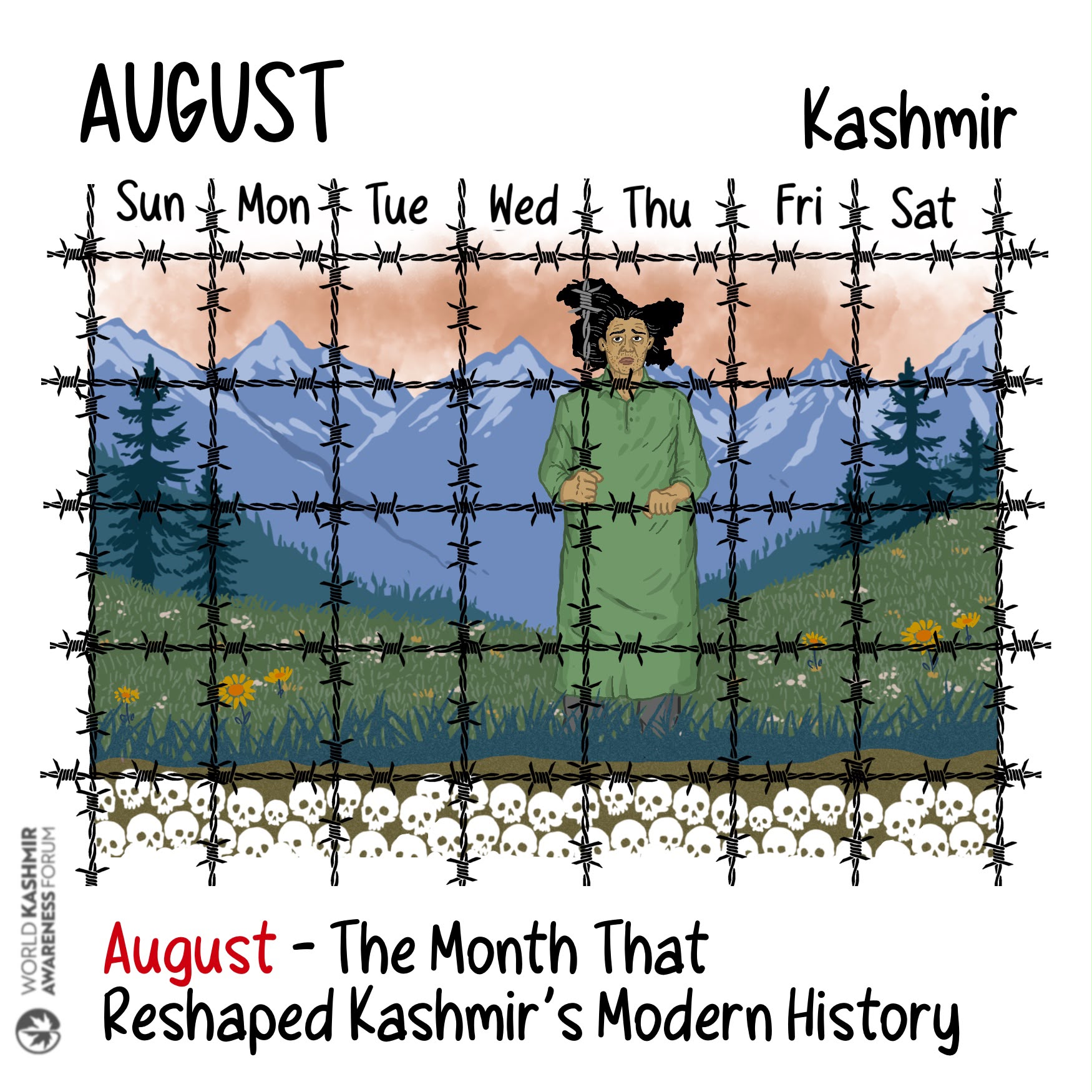
August – The Month That Reshaped Kashmir’s Modern History
To understand why August remains one of the most significant months in Kashmir’s political history, one must examine these recurring turning points not as isolated incidents, but as an interconnected narrative, one that reveals a persistent gap between international commitments and the lived reality of a people seeking self-determination.
The Seed of Division: August 1947 and Partition
The contemporary history of Kashmir was irrevocably altered in August 1947 with the end of British colonial rule and the Partition of the Indian subcontinent into two independent states. Under the legal framework of the Indian Independence Act, princely states were expected to accede to either India or Pakistan, taking into account geographic contiguity and demographic realities.
However, the autocratic ruler of Jammu and Kashmir, Maharaja Hari Singh, attempted to navigate a separate path. In August 1947, his administration signed a Standstill Agreement with Pakistan to maintain trade and communication links while delaying a final decision on accession. India, however, had more sinister designs. It used delay tactics and refused to sign the document.This devious tactic quickly led to collapse of the three way plan \causing regional instability, leading to the outbreak of the first Indo-Pakistani War in late 1947 and the initial division of the territory. The events of August 1947 laid the structural groundwork for what would become one of the world’s most enduring and heavily militarized disputes.
International Promises: The UN Mandate of August 13, 1948
As military confrontation escalated across the region, the dispute was brought before the United Nations Security Council. The international community recognized that the territory’s final political status remained unresolved and required an impartial legal framework.
On August 13, 1948, the United Nations Commission for India and Pakistan (UNCIP) adopted a landmark resolution that outlined a comprehensive three-part structure:
- Part I: A formal ceasefire and the cessation of hostilities.
- Part II: A truce agreement governing the synchronized withdrawal of Indian and Pakistani forces.
- Part III: A binding commitment that the final status of Jammu and Kashmir would be determined through the democratic method of a free and impartial plebiscite under UN auspices.
This August 1948 resolution, alongside subsequent UNSC declarations, established a firm international consensus: the sovereignty of Kashmir belonged to its people, not to regional capitals. UN Secretary General Tryge Lie appointed a prominent American WW II naval officer Admiral Nimitz as the Plebiscite Administrator to oversee a free and impartial plebiscite in Jammu and Kashmir in March 1949 to determine whether the people of Jammu and Kashmir wanted to join India or Pakistan, Indian Prime Minister Jawaharlal Nehru opposed the appointment He would rather have a representative from a smaller country be appointed to that position. So India torpedoed the whole process using yet another ploy.
Internal Disruption and Military Escalation: 1953 and 1965
Throughout the middle of the twentieth century, the month of August continued to mark critical political and military shifts within the region.
On August 9, 1953, Sheikh Mohammad Abdullah, then Prime Minister of Jammu and Kashmir, was abruptly dismissed from office and imprisoned under directives from New Delhi. He remained in prison for no good reason for the next eleven years in different jails in Kashmir and India. His arrest followed growing disagreements over reneging on holding the promised plebiscite, and the erosion of what little constitutional guarantees India had promised. This move marked a major internal shift, signaling a policy of managing Kashmir’s political sphere through direct central authority rather than genuine democratic process.
Twelve years later, in August 1965, the region experienced renewed military escalation. Clandestine operational efforts across the Ceasefire Line rapidly expanded into the full-scale Indo-Pakistani War of 1965. The conflict reinforced how the unresolved political grievances of Kashmir repeatedly threatened broader regional stability in South Asia.
August 5, 2019: Constitutional Unilateralism and Demographic Shift
The most radical structural transformation in Kashmir’s modern history occurred on August 5, 2019. Through a series of presidential orders, the Indian government unilaterally revoked Article 370 and Article 35A of the Indian Constitution which was incorporated into the J&K constitution and gradually eroded by the Indian establishment in cahoots with local Kashmiri quislings— stripping Jammu and Kashmir of its semi-autonomous status and special privileges guaranteeing the so called state subjects of J&K rights to indigenous population permanent residency and land ownership rights.
The state was subsequently bifurcated and reorganized into two centrally administered Union Territories, bringing the region under direct control from New Delhi. This constitutional restructuring was executed under the cover of an unprecedented security lockdown for nine months accompanied by total communication blackouts, strict curfews, and the mass detention of political leaders, activists, and journalists.
For many Kashmiris, the measures of August 2019 represented more than a legal adjustment; they were viewed as the implementation of a broader settler-colonial framework designed to alter the demographic character of the region and suppress local political identity. The removal of land protection laws paved the way for non-locals to acquire property and residency, profound concerns over cultural erasure and indigenous disenfranchisement and land theft and job denials
Preserving Memory as a Pathway to Peace
As we reflect on the historical timeline stretching from August 1947 to the present day, it becomes clear why August holds such weight in the collective memory of the Kashmiri people. It is a month that captures the entire trajectory of the struggle from initial partition and unfulfilled UN resolutions to internal political suppression and sweeping constitutional changes.
In an environment where political dissent and civil liberties face severe restrictions, the preservation of historical memory becomes an active form of resilience. Attempting to manage a political dispute through militarization, digital censorship, and demographic rewriting cannot substitute for a genuine resolution anchored in justice.
A sustainable and peaceful future for Jammu and Kashmir requires moving away from security-driven policies and unilateral decrees. It demands:
- Restoration of Rights and Liberties: Reversing draconian legal measures and ensuring fundamental freedoms of expression, assembly, and political participation.
- Centered Kashmiri Representation: Recognizing that no diplomatic framework or regional dialogue can succeed without genuine, direct representation from the Kashmiri people.
- Adherence to International Law: Re-anchoring peace efforts in the principles of self-determination and human rights originally guaranteed by global institutions.
The legacy of August serves as both a record of historical grievance and an enduring reminder that true stability in Kashmir cannot be imposed by force; it can only be achieved when the rights, dignity, and political aspirations of its people are honored. Kashmiris are a multi-faith, mult-ethnic and multilingual nation of 23 million who have a long history of peaceful co-existence unlike many parts of India. That is what they are dreaming of and that is why they have given sacrifices and that is exactly why they are resisting the tyranny of 80 long years.


