Kashmir in October: A Month of History, Broken Promises, and Unfinished Questions
Examining these historical developments provides an essential analytical framework for understanding how early international commitments transformed into decades of institutional impasse and why the demand for human dignity and self-determination remains as relevant today as ever.
The Historical Arc: October Across the Decades
Understanding Kashmir’s modern political reality requires connecting the events of October across three distinct eras of its history.
October 1931 – The Mobilization for Basic Rights
Following the historic uprisings of July 13, 1931, the momentum of popular resistance against the autocratic Dogra monarchy gathered unprecedented strength by October 1931. Across Srinagar, Anantnag, and the wider valley, Kashmiris organized widespread civil disobedience demanding political representation, an end to oppressive taxation, and basic religious and civil liberties. The October 1931 mobilizations proved that the demand for rights was not a fleeting moment of unrest, but the formal awakening of a collective political consciousness.
October 1947 – Accession, Ingress, and Unfinished Sovereignty
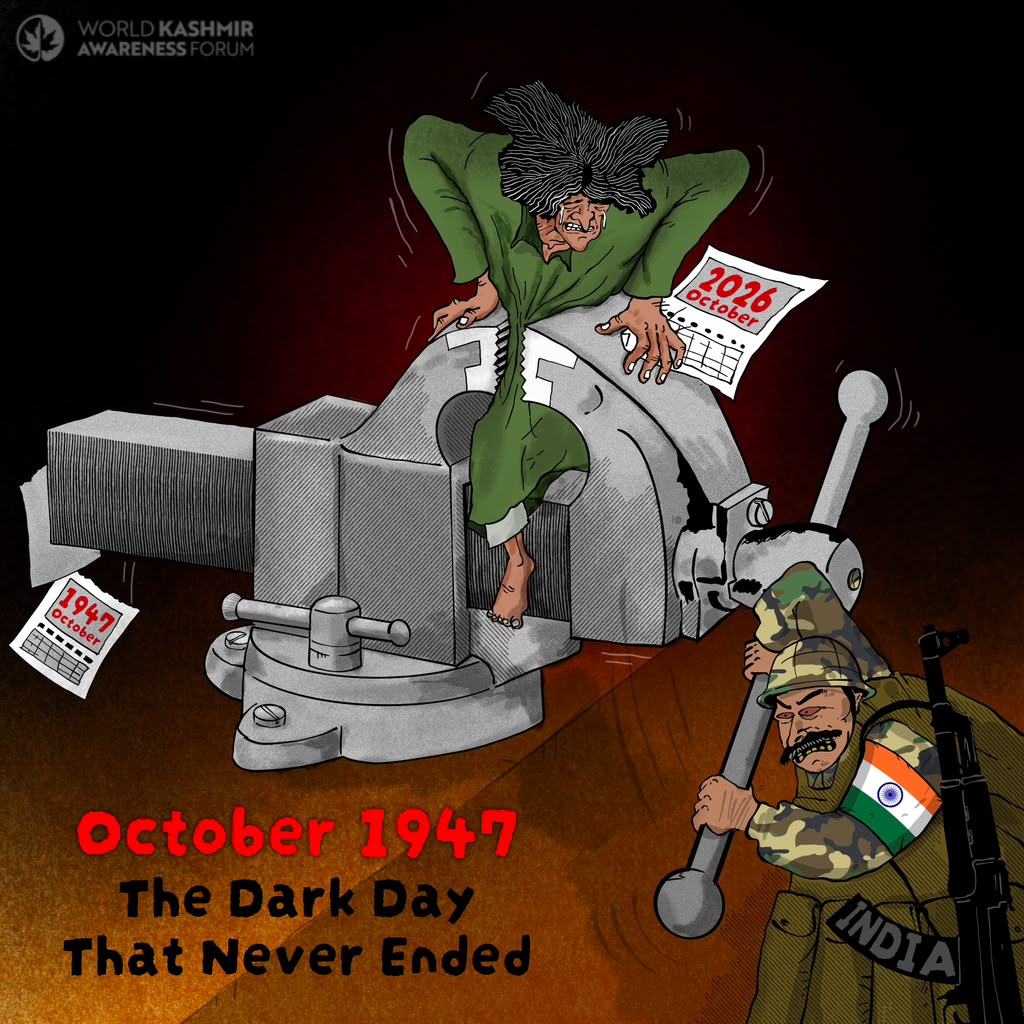
The most consequential month in modern South Asian history occurred in October 1947. Following the Partition of British India, the princely state of Jammu and Kashmir found itself in a precarious state of neutrality under Maharaja Hari Singh. By mid-October, escalating internal rebellions in Poonch and an influx of armed tribal fighters from the northwest rapidly destabilized the regime.
On October 26, 1947, under the pressure of advancing forces, the Maharaja signed the controversial Instrument of Accession with India. Indian troops landed in Srinagar the following morning, initiating the first Indo-Pakistani War. Crucially, the accession was accepted by the British Governor-General, Lord Mountbatten, with an explicit legal caveat: the accession was provisional, and as soon as law and order were restored, the question of the territory’s final affiliation would be settled by a reference to the people.
October 1993 – The Bijbehara Massacre
Decades later, the physical cost of managing a political conflict through military force was tragically underscored on October 22, 1993, in the town of Bijbehara. Following days of tension surrounding the siege of the Hazratbal shrine in Srinagar, thousands of peaceful civilian demonstrators gathered in Bijbehara after Friday prayers to protest the military encirclement.
Border Security Force (BSF) personnel opened fire on the crowded streets, killing over 50 unarmed civilians and injuring more than 100 others. The Bijbehara massacre stands as one of the most stark examples of civilian vulnerability under extraordinary security laws, illustrating the severe human rights cost when peaceful assembly is met with lethal force.
Broken Promises: Nehru’s October 31, 1947 Correspondence
A central element of the legal debate surrounding Kashmir is the solemn documentation of commitments made at the highest levels of statecraft during the critical days of October 1947.
On October 31, 1947, Indian Prime Minister Jawaharlal Nehru sent a formal telegram to the Prime Minister of Pakistan, Liaquat Ali Khan. In this historical correspondence, Nehru explicitly outlined the temporary nature of India’s military presence and reaffirmed the democratic principle governing the territory:
“Our assurance that we shall withdraw our troops from Kashmir as soon as Kashmir is cleared of the invader and law and order is established is total and absolute… We have declared that the fate of Kashmir is ultimately to be decided by the people. That pledge we have given, and the Maharaja has supported it, not only to the people of Kashmir but to the world. We will not and cannot back out of it.”
This telegram, alongside similar public broadcasts by Indian leadership throughout late 1947, established an unmistakable moral and legal precedent. It affirmed that sovereignty resided with the population of Jammu and Kashmir, establishing a solemn pledge that would later form the foundation of multiple United Nations Security Council resolutions.
The Core Deficit: Human Rights and Political Representation
Looking at the trajectory from October 1947 to the present, a persistent theme emerges: the systematic exclusion of Kashmiri agency from diplomatic processes.
For decades, international discussions have frequently reduced Kashmir to a bilateral real estate dispute between New Delhi and Islamabad. This state-centric framing fundamentally ignores the primary stakeholder the Kashmiri people. When diplomatic dialogues or security arrangements are negotiated over the heads of the population, they inevitably fail to address the root causes of instability.
Furthermore, the implementation gap between global human rights declarations and local realities remains vast. The continuous application of draconian statutes, the restriction of press freedoms, and the criminalization of political dissent have created an environment where basic civil liberties are treated as security concessions rather than fundamental rights.
Connecting Memory to Present Challenges
The history of October is not a distant chronicle of archived documents; it is a living narrative that directly informs the present.
When modern policies attempt to enforce a manufactured silence through administrative restructuring or the erasure of historical memory, they overlook the core lesson of the past eight decades: an artificial quiet maintained by security apparatuses cannot be mistaken for a genuine political consensus.
A sustainable path forward requires confronting the unresolved questions of October with intellectual honesty and legal accountability. It demands:
- Honoring Historical Commitments: Recognizing that lasting peace must be anchored in the principles of justice, self-determination, and international law originally promised to the region.
- Protecting Civil Liberties: Ending the severe restrictions on freedom of expression, peaceful assembly, and political organization.
- Centering Kashmiri Voices: Ensuring that any meaningful dialogue prioritizes the direct, unrepresented perspectives and political aspirations of the Kashmiri people.
As the memory of October reminds us, history cannot be erased by administrative decree. True stability will remain elusive until the promises of the past are met with the justice of the present.