
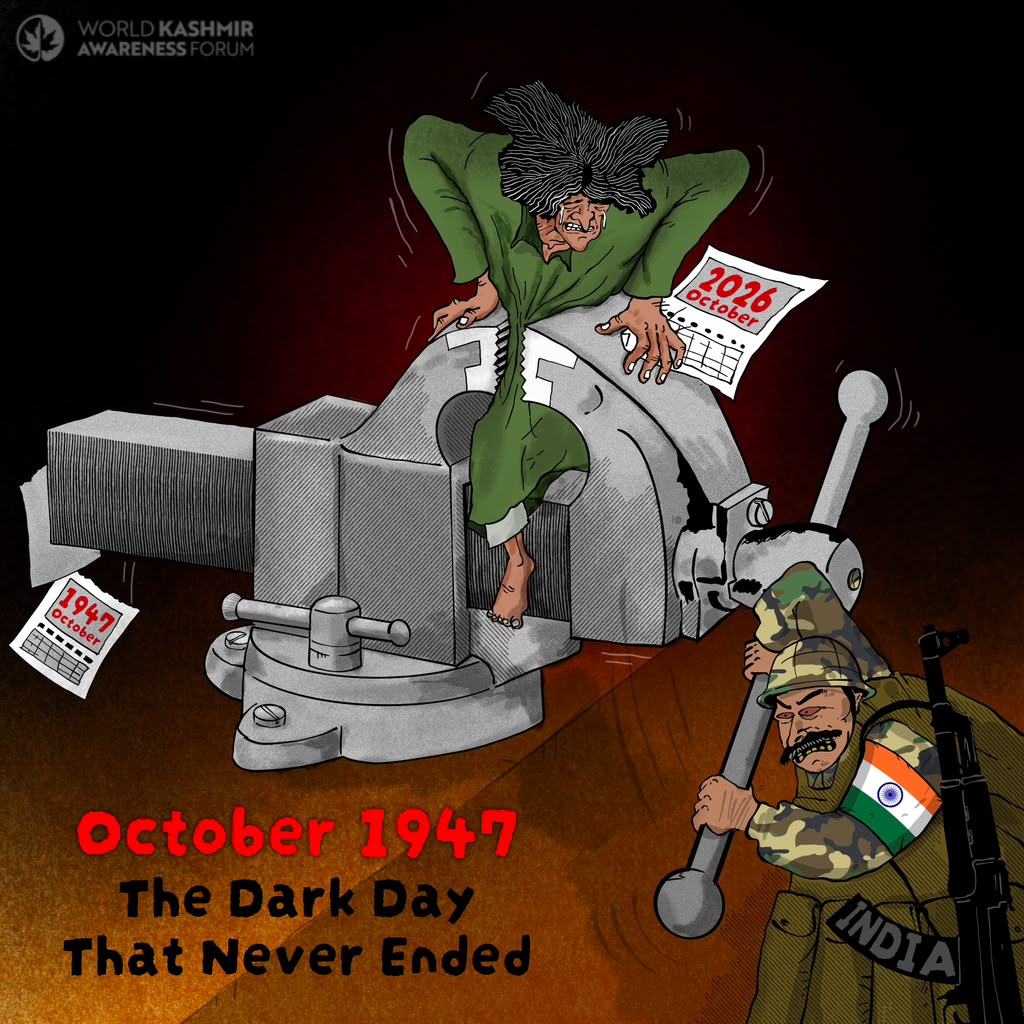
October, Promised and Unkept
Two dates frame that question. On October 31, 1947, India promised in writing that the people of Kashmir would decide whether to join India or Pakistan. On October 31, 2019, seventy-two years later to the day, India formalized its control over Kashmir. Indian rule had never depended on the consent of Kashmiris, and the autonomy promised in 1947 had been hollowed out for decades (Kanjwal 2023). In August 2019 India removed what was left of it, revoking the semi-autonomous status of the state along with the protections that reserved land and jobs for its residents, and passing a law that turned Jammu and Kashmir into a Union Territory governed from Delhi, with Ladakh cut away as a separate one. That law took effect on October 31. Kashmiris were never asked. The valley had been under lockdown since August, and on the day the law took effect, its internet was still cut and hundreds of its political leaders were still in detention.
October 1947 and the Accession
As we wrote in September, Kashmiris had lived for a century under Dogra rulers whom the British installed in 1846, and who met Kashmiri protest with force. When British rule over India ended in August 1947, the Dogra ruler, Hari Singh, refused to join either India or Pakistan. By then Muslims in Poonch, a district in the west of the state, had risen in revolt against his rule. In October, Pashtun fighters from the Northwest Frontier Province of Pakistan, angered by the killing of Muslims in Jammu and Poonch, crossed into the state and moved along the main road toward Srinagar.
On the night of 25 October, Hari Singh loaded around a hundred trucks with his valuables and fled Srinagar for Jammu. On the morning of October 27, aircraft carrying Indian soldiers began landing at the airfield in Badgam, just outside Srinagar. One resident on the outskirts of the city later recalled the soldiers as aggressive, and accounts of those first days put the number of Kashmiri civilians killed by the arriving troops at between four and eleven (citing from Mir 2020). India says the troops came lawfully because Hari Singh had signed an Instrument of Accession, a document joining his state to India, dated October 26. But Mehr Chand Mahajan, the prime minister of Hari Singh, wrote in his memoir that he flew to Jammu to get the document signed only after he heard that the troops had landed. The British historian Alastair Lamb found evidence in the British archives supporting this, and the historian Andrew Whitehead concludes that the weight of evidence shows the document was signed on 27 October, hours after the troops arrived. Indian soldiers were already in Kashmir before the document that India uses to justify their presence had been signed.
The soldiers who landed that morning were the first of a force that has for decades numbered at
least half a million, and by some estimates more than 700,000, which makes Kashmir one of the most militarized places in the world. In the years that followed, the borders that had connected the valley to Central Asia, long one of its most important trading partners, were sealed. A ruler who had governed Kashmiris by force had fled, and a new occupying power had arrived with an army.
The Promise of 31 October
India built its claim to Kashmir on a promise. On October 27, Mountbatten, the British Governor General of India, accepted the accession with a letter stating that once “order” was restored, the question of accession “should be settled by a reference to the people.” On October 31, Nehru repeated the commitment in a telegram to the Prime Minister of Pakistan, and in early November he told his own country by radio that the fate of Kashmir would be decided by its people, and “we will not and cannot back out of it.” Years later, the United States government still regarded those assurances of October 1947 as committing India to a plebiscite. The promise was made in the same weeks that Muslims in Jammu were being driven from their homes and killed, in territory that India now claimed to protect. In early November, Muslim families who had been promised lorries to safety in Sialkot were taken instead to the hills and killed. When Nehru and Sheikh Abdullah were told what had happened in Jammu, they chose to stay silent. India said little about Jammu, and a great deal about Baramulla, the town where the Pashtun fighters had looted homes and killed residents, including a British officer and his wife at the Catholic mission. Kashmiri historians, among them Yusuf Saraf of Baramulla, have recorded those killings while also showing how far India exaggerated them for its own purposes.
Read the documents of that week together and notice what they concede. A state certain of its rightful claim does not need to promise a vote. The promise was an admission, written down for the world, that the future of Kashmir was not yet settled, and that only Kashmiris could settle it. As we wrote in September, India refused the arbitration that might have made the vote possible in 1949. In 1953 it dismissed and arrested Sheikh Abdullah at the behest of Nehru when Delhi came to suspect him of seeking independence, and he spent most of the next eleven years in prison.
Bijbehara, October 1993
On the night of October 15 in 1993, the Indian army laid siege to Hazratbal, the holiest Muslim shrine in Kashmir, where relics of the Prophet Muhammad are kept. On 22 October, the eighth day of the siege, thousands of people in the south Kashmir’s town of Bijbehara walked out of their Jamia Masjid after Friday prayers to protest. Soldiers of the 74th Battalion of the Border Security Force, an Indian paramilitary force, opened fire. Official sources at the time admitted at least 37 dead, and Amnesty International counted at least 51. Families who later went to court named 32 of the dead. Many were schoolboys, and the park in New Colony where they had played cricket became their graveyard.
Within a month, the enquiry magistrate appointed by the government found the firing unprovoked and the official claim that soldiers had been fired upon invented. The accused were tried by their own force and acquitted. The National Human Rights Commission of India asked for the case files and was refused. No one has ever been punished. Forty six years after the promise that Kashmiris would decide their own future, people who gathered after prayers to speak were shot dead in the street.
October 2019 and After
On 5 August 2019, India revoked Article 370, the constitutional provision that had recognized Jammu and Kashmir as a state with its own constitution, along with the protections that reserved land and government jobs for its permanent residents. It did so with the region under lockdown, telephones and internet cut, and thousands detained, including almost every local political leader and children as young as nine. On 31 October 2019, the anniversary of the telegram of 1947, the state was formally split into two Union Territories ruled directly from Delhi. When the Supreme Court of India upheld the revocation in December 2023, it declined to rule on whether dissolving a state was even lawful, because the government had promised to restore statehood as soon as possible. Elections were held in 2024, and the elected Assembly has asked for statehood again and again. When it took up yet another resolution in September 2026, the Chief Secretary and the Law Secretary, senior officials who answer to Delhi, wrote to the Assembly asking that it not be debated. The Chief Minister, who also holds the law portfolio, told the House he had known nothing about the letters.
Meanwhile, the machinery of control runs on. In July 2026 alone, rights groups including the Kashmir Law and Justice Project documented more than 3,500 detentions, the demolition or seizure of homes belonging to at least 26 families, and an order to purge “anti-national” material from schools and colleges. In September 2026 the High Court ordered the release of Shafat Maqbool Wani, a research scholar from Kupwara who had been held for more than 500 days under the Public Safety Act, a law that allows detention for up to two years without charge or trial. Among the grounds the state gave for holding him were the books on his shelves and invitations to academic conferences at Columbia University and Dublin City University.
The Question October Keeps Asking
Set the Octobers side by side. In 1947, India promised in writing that Kashmiris would decide their own future, while Muslims in Jammu were being killed in territory it claimed to protect. In 1993, people who gathered after Friday prayers in Bijbehara were shot. In 2019, on the anniversary of that promise, the state was dissolved without a vote. In 2026, an elected Assembly was told by officials answering to Delhi that it should not even debate its own future, and a scholar was held for the books he read and the conferences he was invited to.
The fight over which October day is remembered is a fight over this record. A holiday for 26 October tells the story of a lawful accession. Black Day on 27 October tells the story of an army that arrived before its paperwork. The promise of 31 October tells a third story, one India would rather forget, in which the future of Kashmir was always meant to belong to Kashmiris. That promise has never been withdrawn. It has only never been kept.
Further Reading
Hafsa Kanjwal, Colonizing Kashmir: State-Building under Indian Occupation (Stanford University Press, 2023)
Christopher Snedden, Kashmir: The Unwritten History (HarperCollins, 2013)
Anuradha Bhasin, A Dismantled State: The Untold Story of Kashmir after Article 370 (HarperCollins, 2022)


