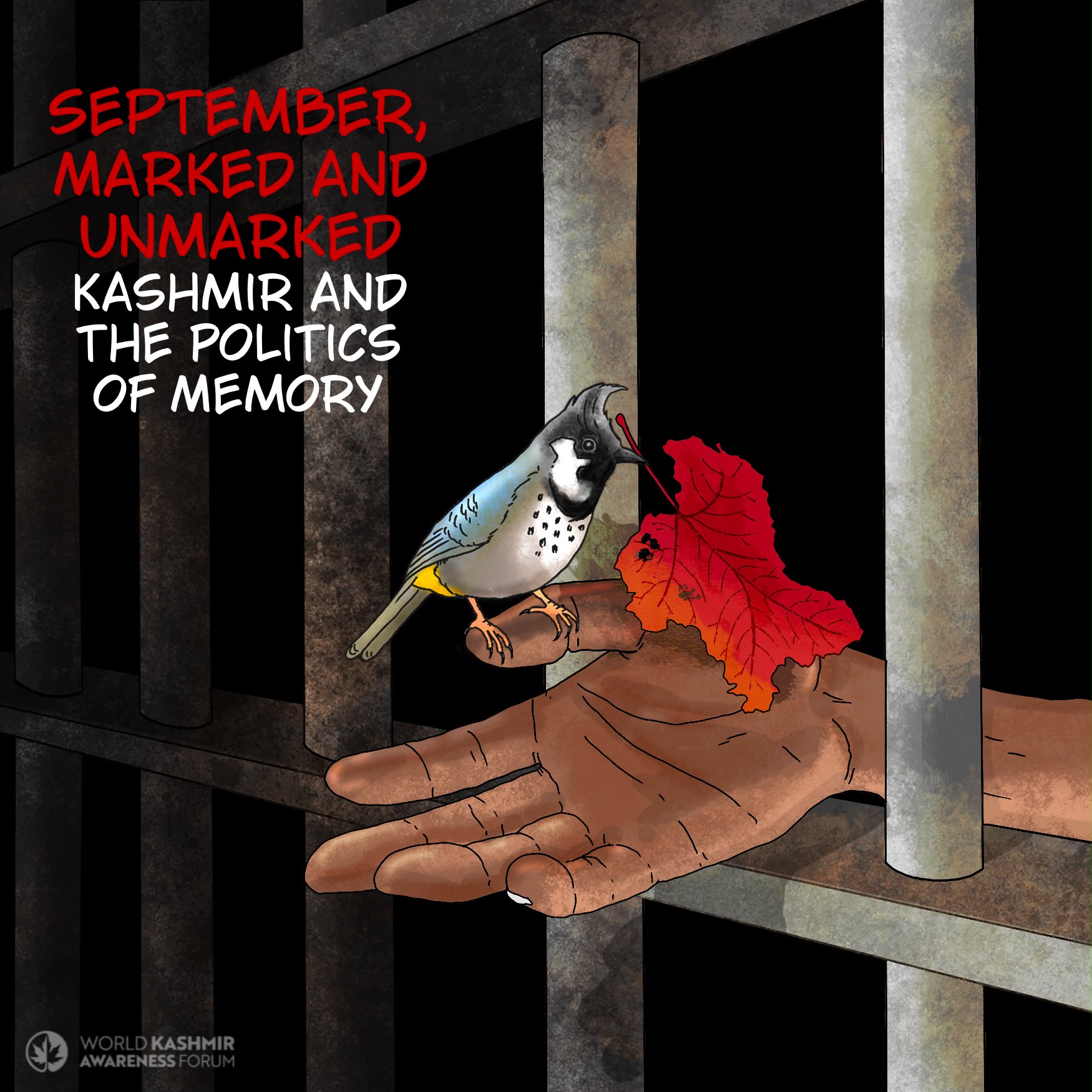
September, Marked and Unmarked: Kashmir and the Politics of Memory
Every September 23, government offices and schools across Jammu and Kashmir close. Since 2022, the date has been an official holiday for the birthday of Hari Singh, the last Dogra ruler of Kashmir. It arrived after July 13, the day Kashmiris mourn those killed by Dogra troops in 1931, was taken out of the official calendar following the revocation of Article 370 in August 2019.
The exchange of one date for another might seem a small administrative act, but it shows a larger pattern. For decades, Kashmir has been narrated as a territorial dispute between India and Pakistan, in which the people of Kashmir, their histories and their aspirations have not been foregrounded (Kanjwal 2023). From where Kashmiris stand, September holds a different history, an uprising in which people rejected a truce made on their behalf, a UN process that promised a plebiscite but offered only two choices, and a long struggle over what is allowed to be remembered.
The Uprising of September 1931
From 1846, when the British handed the territory to the Dogra rulers of Jammu under the Treaty of Amritsar, a largely Muslim population in Kashmir lived under a Hindu dynasty backed by British power. By 1931, heavy taxation, low wages and state monopolies had fuelled deep resentment (Kashmir Times), sharpened by interference in religious life, including a police intervention that halted a Friday sermon in Jammu that April.
On July 13, 1931, thousands gathered outside the Central Jail in Srinagar for the trial of Abdul Qadeer, arrested for urging Kashmiris to rise against Dogra rule. When a man in the crowd began the call to prayer, troops shot him, and another stepped forward to continue it. Twenty two people were killed. Kashmiris have marked it as Martyrs Day ever since. In late August, Muslim leaders agreed a truce with the Dogra government, but when its terms were announced at Jamia Masjid, the main mosque of Srinagar, many rejected it.
In September, the uprising spread, and parts of the movement turned to open defiance of the Dogra government.
- On September 22, troops fired on processions at Jamia Masjid and Maisuma, killing three and wounding more than a dozen.
- On September 23, people were killed in Pulwama, a day that eyewitnesses there still remember as a martyrs day.
- On September 24, around fifteen thousand people gathered in Srinagar carrying axes, spears and sticks, a force known as the Narchu Paltan. Notices posted across the city, recorded in a telegram from the British Resident, declared that Muslims had “no quarrel with the Hindus but have declared Jihad against his highness government.” That same day, troops opened fire on a procession of women in the Maisuma bazaar, killing a woman named Fazli.
Women stood at the centre of the uprising. As early as August 14, observed that year as Kashmir Day, some thirty thousand women gathered at the graveyard where the July martyrs were buried. In the weeks that followed, women led processions in Srinagar and in Baramulla, Sopore, Islamabad (Anantnag) and Shopian. In Shopian that year, troops shot Sajida Bano, a 25 year old widow who was pregnant, killing her and her unborn child.
Unable to contain the unrest, and at British insistence, Hari Singh appointed the Glancy Commission in November 1931 to examine Muslim grievances. The movement of that year laid the ground for the Muslim Conference, founded in 1932, and for the Kashmiri political organising of the decades that followed.
September 1949 and the Deferred Plebiscite
In 1947, the question changed from how Kashmir was ruled to who would rule it. As the British partitioned the subcontinent and withdrew, the future of the state was still undecided. From the spring of 1947, Poonch was in rebellion against Dogra rule. Where many men had served in the British Indian Army, anger at heavy taxation had grown into open resistance, and from August, Dogra forces fired on crowds and burned villages (Snedden 2013). In Jammu, in October and November, Dogra state forces and those acting with them killed and expelled Muslims in a state sponsored effort to make the province Hindu majority (Rasool, in Fareed 2017). By one contemporary account, as many as 237,000 Muslims were “systematically exterminated,” though estimates vary widely (The Times, 10 August 1948, cited in Geelani). This massacre is largely erased in Indian nationalist histories (Kanjwal 2024). Days after the killings in Jammu began, Pathan fighters from the North West Frontier of Pakistan entered the state, seeking, as they saw it, to free it from Dogra rule. Hari Singh turned to India, which promised military aid on condition that he sign an Instrument of Accession. He signed on October 26, though when and under what conditions remain contested (Kanjwal 2024), and Indian and Pakistani forces went to war.
In January 1948, India took the question to the United Nations, where it was treated as a dispute between two states. The United Nations Commission for India and Pakistan (UNCIP) secured two agreements. Under its resolutions of August 1948 and January 1949, both countries accepted a ceasefire, the withdrawal of forces, and a “free and impartial plebiscite” to decide the future of the state. The ceasefire took effect on January 1, 1949, and the American admiral Chester Nimitz was named to administer the vote.
The vote never came. By June 1949, US diplomats reported that members of the Commission had further doubts about whether India meant to honour its commitment. In July, a ceasefire line was drawn through the middle of the state. The two governments could not agree on which troops would leave, in what order, and how many. To break the deadlock, the Commission proposed at the end of August that Nimitz arbitrate, and President Truman urged both prime ministers to agree. On September 8, Pakistan accepted. India replied the same day and refused. Nehru wrote that India was “not opposed to principle of arbitration”, but he rejected the proposal. In December, India also turned down a new proposal from General McNaughton, then President of the Security Council, and the US ambassador in Delhi saw no basis for expecting India to change its position. By March 1950, the Commission had been wound up and replaced by a single UN representative.
These exchanges survive in the declassified records of the US State Department, and they show where the process broke down. India had formally agreed that the final status of the state would be decided by the will of its people through a plebiscite, and then refused the proposals meant to make that vote possible. And even the plebiscite that was promised would have offered only a choice between joining India or Pakistan. Independence was never one of the options. September 1949 marks the point at which that promise began to be deferred. It has not been fulfilled since.
Yasin Malik and the 1994 Ceasefire
The question September 1949 left open did not go away. In the decades that followed, it was kept alive and suppressed in turn. The Plebiscite Front campaigned for the promised vote from 1955 until it was dissolved in 1975 (Kashmir Life). Maqbool Bhat, whose National Liberation Front was the forerunner of the Jammu Kashmir Liberation Front (JKLF), went further and argued for the choice left off the ballot in 1949, a Kashmir independent of both India and Pakistan. On February 11, 1984, he was hanged in Tihar jail, where his body was buried in the jail compound (Free Press Kashmir). Within a few years, a younger generation carried his demand into armed struggle. Among them was Yasin Malik, born in 1966 in Maisuma (Al Jazeera). The rigged state election of 1987, and the mass arrests that followed, drove many to armed groups. Many joined the JKLF, which took up that demand. Its armed struggle is usually dated to July 31, 1988, when its HAJY group of Ashfaq Majeed Wani, Abdul Hamid Sheikh, Yasin Malik and Javid Mir carried out its first armed action in Srinagar, meant, as they later described it, as a message that Kashmiri youth were ready to face the Indian state.
Two years later, the course of his life changed. On August 6, 1990, Malik was arrested, and he spent nearly four years in prison. When he was released on bail in May 1994, he announced that the JKLF would stop its armed struggle. He called this ceasefire the “Modus Vivendi.” The JKLF still wanted an independent Kashmir, and it went on demanding one, but now without arms. Malik vowed to carry on the struggle “come what may.” This decision divided the movement. In 1995, JKLF founder Amanullah Khan, who wanted to continue the armed struggle, and Malik removed each other from the leadership. In March 1996, Indian troops attacked the headquarters of the faction that had rejected the ceasefire, near the Hazratbal shrine, and killed 22 people, including its leader Shabir Siddiqui. Amnesty International reported that JKLF members had been “reportedly deliberately killed by state police” that month.
For the next twenty five years, Malik practised unarmed politics in the open. The JKLF was part of the Hurriyat until it split in 2003. Malik mobilised crowds, called shutdowns and election boycotts, and was detained again and again. He met the Indian Prime Minister Manmohan Singh in 2006, in talks that brought no breakthrough. In 2010, and again in 2016 after the killing of Burhan Wani, he joined Syed Ali Shah Geelani and Mirwaiz Umar Farooq to lead the mass protests.
Then the state went further. On March 22, 2019, months before India revoked Article 370, the Modi government banned the JKLF under its antiterror law. Among its stated reasons was that the group was “supporting and inciting claims for the secession of a part of the Indian territory.” The demand for independence itself had been named a crime, part of a longer pattern in which Kashmiri political aspirations have been criminalised (Kanjwal 2024). In May 2022, Malik was sentenced to life in prison on charges he called “concocted, fabricated and politically motivated.” If seeking azadi was a crime, he told the court, he was ready to accept it. Prosecutors have since appealed for the death penalty.
The ceasefire has been read in very different ways. For many Kashmiris, it was a continuation of the struggle by other means, and they stood by Malik. That became clear in May 2022. On the day he was sentenced to life, shops and markets across most of Srinagar closed on their own, without any call for a shutdown, and parts of the city stayed shut for two more days. Others in the JKLF saw the ceasefire as abandoning the struggle. To them, armed resistance was the heart of the movement, and giving it up meant giving up the fight. Malik has since given his own account, in an affidavit filed in the Delhi High Court in August 2025 as he faced the death penalty appeal. He describes years of talks in prison with Indian officials, who pressed him to bring the movement into open politics. In 2019, the state reopened the old cases against him. The Indian state, for its part, treats the ceasefire as if it changed nothing. It accused a movement that had not taken up arms in a quarter of a century of “supporting extremism and militancy,” turning the language of militancy against unarmed politics.
Whatever one concludes about Malik, the record is clear. A movement that had taken up arms laid them down and pursued independence in the open. The Indian state answered with arrests, a ban and a life sentence for its leader, and now seeks his execution.
To Revisit the Record
Beyond banning movements and imprisoning their leaders, the state has taken on the power to decide how Kashmir remembers, which days are marked, which dead may be mourned and which books may be read. The removal of July 13 from the calendar was one such decision. Another came in September 2021. When Syed Ali Shah Geelani, for decades one of the leading voices of Kashmiri resistance, died on September 1 after more than a decade under house arrest, police took his body at 3am and buried him before his family could gather for the funeral prayers. The internet was cut across Kashmir, the Indian military lined the roads, and days later police filed a case against members of his family under the antiterror law. A third came in August 2025, when authorities banned 25 books, claiming they promoted “a culture of grievance, victimism” and encouraged “participation in violence and terrorism.” They include works by scholars of critical Kashmir studies, the journalist Anuradha Bhasin, the historian of the freedom struggle Mohammad Yusuf Saraf, and the Kashmiri researchers who documented the mass rapes by Indian soldiers at Kunan Poshpora.
What gets written, preserved and allowed to be read has always been shaped by those in power (Trouillot 1995; Said 1984). In Kashmir, each of these decisions uses an administrative order to settle a question that remains politically unresolved, whose dead are honoured, whether the promise of a plebiscite still stands, whether the demand for independence is politics or a crime. These questions shape debate about Kashmir, and each depends on how the past is told.
Revisiting the record therefore means reading official archives critically and preserving what they leave out, the testimony and memory of Kashmiris themselves. Read that way, the record keeps returning to one question. In 1931, Kashmiris rose against Dogra rule and refused a truce made on their behalf. In 1949, they were promised a plebiscite, and it was deferred. In 1994, the JKLF gave up arms for open political struggle and was later banned all the same. Each time, the question of who decides the future of Kashmir was set aside rather than answered. Without that record, the debates of today rest on a history that has been partly erased. With it, the question stays open, and stays with the people it belongs to.
History is not only what we remember. It is what we continue to examine.