
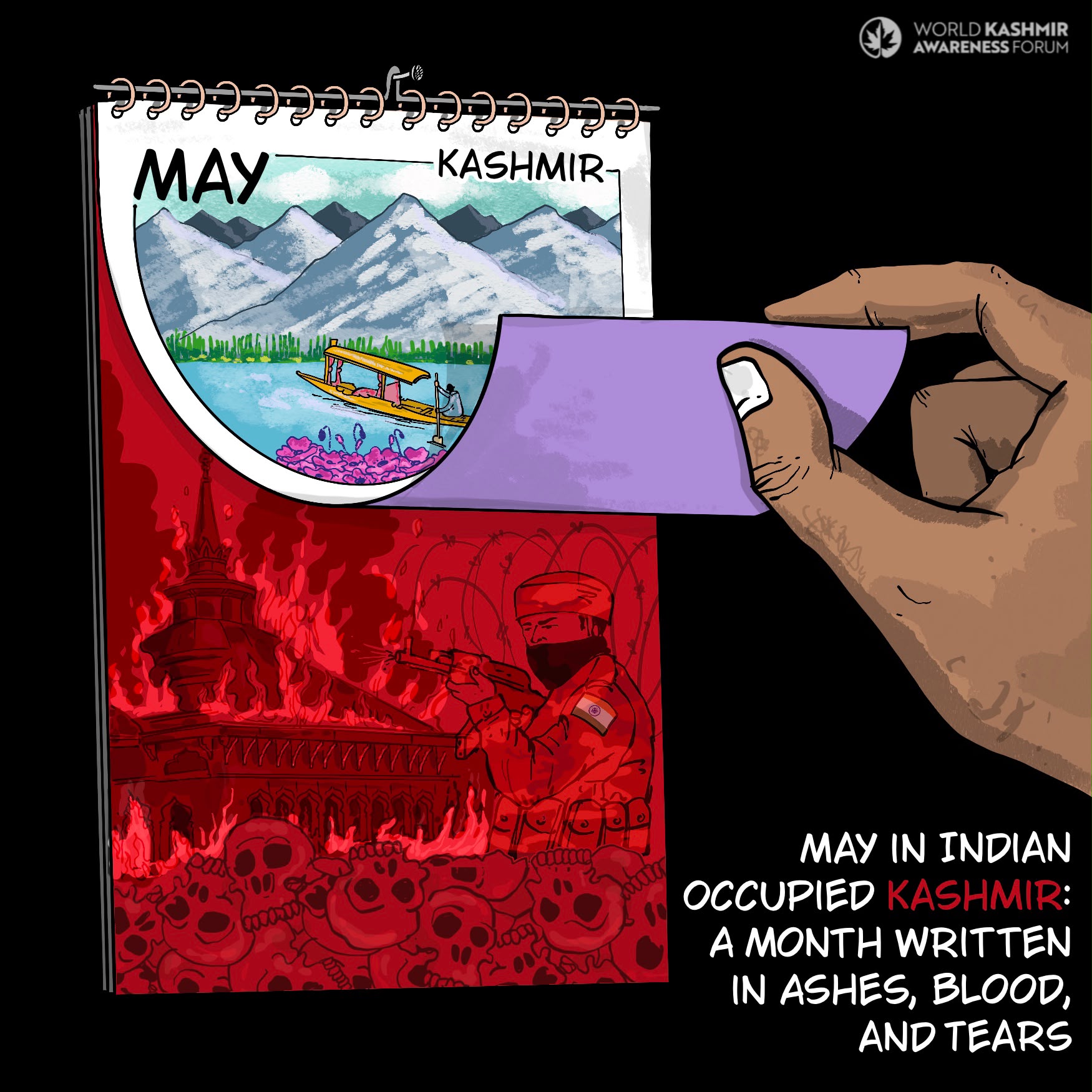
May in Indian Occupied Kashmir: A Month Written in Ashes, Blood, and Tears
For the people of Indian-occupied Kashmir, months are not measured by the changing of seasons, but by the weight of their tragedies. Time in the valley does not flow naturally; it is anchored to a long continuum of grief, memory, and state-sponsored violence. When May arrives, it does not bring the warmth of spring. Instead, it reopens wounds that run deep into the soul of the Kashmiri nation. May is a month written in ashes, blood, and tears, a reminder of the systematic effort by the occupying regime to crush both the physical bodies and the cultural identity of Kashmiris.
The Burning of Charar-e-Sharief: An Attack on Faith
The story of May cannot be told without speaking of the ashes of Charar-e-Sharief. In May 1995, the Indian military laid siege to the historic town of Budgam, culminating in the destruction of the 600-year-old shrine of Sheikh Noor-ud-Din Wali, the patron saint of Kashmir. The burning of this sacred wooden structure was not an accident of war; it was a clinical attack on the very pillars of Kashmiri identity and Islamic faith.
For centuries, Charar-e-Sharief was more than a religious building; it was the spiritual heart of the valley, representing the distinct indigenous culture of Kashmir. By reducing the shrine and thousands of surrounding homes to ashes, the Indian state sent a clear message. The destruction was an early manifestation of the Hindutva project’s desire to erase the Islamic footprint from the region. The smoke that rose from the shrine in 1995 still hangs over the collective consciousness of the people, proving that the regime’s war is not just against bodies, but against the memory and faith of the population.
Silencing the Leadership: The Hawal and Srinagar Massacres
May is also the month that claims the architects of the Kashmiri political struggle. On May 21, 1990, the beloved spiritual and political leader, Mirwaiz Maulvi Muhammad Farooq, was assassinated. His murder was shocking, but the state’s response was catastrophic. As a massive crowd of grieving citizens carried his coffin through the streets of Srinagar toward the Hawal area, Indian paramilitary forces opened fire without warning.
The Hawal massacre left over sixty civilians dead, their blood staining the very streets where they sought to mourn. The regime could not tolerate even the shared grief of an occupied people. Twelve years later, on the exact same day in 2002, another prominent pro-freedom leader, Abdul Ghani Lone, was assassinated during a memorial service for Mirwaiz. These targeted killings were part of a deliberate strategy by New Delhi to leave the Kashmiri people politically orphaned, systematically eliminating leadership that refused to compromise on the right to self-determination.
The Weapon of Gendered Violence: Dialgam and Shopian
The pain of May is carried with particular weight by Kashmiri women, who have long borne the brunt of the occupying forces’ brutality. The Dialgam tragedy stands as a grim chapter in this history, where women faced horrific violence and harassment at the hands of security forces during cordon-and-search operations. In the systemic framework of Indian rule, the bodies of Kashmiri women have been treated as a battlefield, used by the military to inflict collective trauma and humiliate entire communities.
This dark reality was exposed again in May 2009 during the Shopian tragedy. Two young women, Asiya and Neelofar, were abducted, raped, and murdered near an army camp in Shopian. When their bodies were found in a shallow stream, the state machinery immediately went into overdrive to cover up the crime. Government officials claimed the women had simply drowned in ankle-deep water.
The Shopian tragedy deeply scarred Kashmiri society. It showed that the legal system in occupied Kashmir offers no justice for the colonized. The complete impunity granted to the armed forces by draconian laws means that the state can protect rapists and murderers while silencing the families who demand answers.
The Illusion of Peace: The 1997 Dialogue
There was a time when even India and Pakistan acknowledged that the Kashmir dispute required political engagement rather than military management. In May 1997, high-level talks between the two countries offered a brief glimmer of hope. Yet despite discussing Kashmir’s future, the process largely excluded the direct participation of Kashmiri representatives, reinforcing a pattern in which decisions about Kashmir were often debated without Kashmiris themselves having a seat at the table.
Even this limited diplomatic opening was short-lived. Rather than pursuing a political process that included the voices and aspirations of the Kashmiri people, the Indian state increasingly relied on militarization and security-driven policies to manage the conflict. The failure to build upon the dialogue of 1997 became another missed opportunity to address the underlying political grievances at the heart of the dispute. For many Kashmiris, it reinforced the perception that their future would continue to be shaped by others while their own demands for dignity, representation, and self-determination remained unresolved.
The Silence of the International Community
Despite decades of documented massacres, forced disappearances, and cultural erasure, the international community remains a passive spectator. The global powers that claim to defend human rights look away from the valleys of Kashmir, blinded by economic interests and geopolitical alliances with New Delhi.
This international silence has often been interpreted by Indian authorities as a lack of accountability. Each time global institutions fail to uphold their own commitments and resolutions on Kashmir, it creates space for further restrictions on civil liberties, political expression, and dissent. Many Kashmiris argue that this absence of meaningful international action has enabled not only the continued militarization of the region but also policies they view as advancing a broader project of demographic transformation and settler colonialism. For many, prolonged inaction by the international community has deepened a sense of abandonment, raising difficult questions about the credibility of international law and the world’s commitment to justice, human rights, and the protection of peoples living under occupation.
Kashmir Still Waits to Be Heard
The history of May in Kashmir is not merely a collection of dates on a calendar. It is a record of grief, resilience, remembrance, and resistance. Across the decades, May has witnessed moments that left deep scars on the collective memory of the Kashmiri people—events that continue to shape lives, families, and communities today. Yet despite attempts to suppress these memories, they endure in the stories passed down through generations, in the graveyards scattered across the valley, and in the determination of a people who refuse to forget.
The passage of time has not resolved the underlying political question of Kashmir. While governments may seek to impose silence through force, silence born of fear cannot be mistaken for peace. The events remembered each May serve as a reminder that justice delayed does not erase injustice. For many Kashmiris, the demand remains unchanged: dignity, representation, and the right to determine their own future. Until those voices are genuinely heard, the history of May will continue to stand as both a testimony to suffering and a call for accountability.


