When the Earth Refuses Silence: Maqbool Bhat, Afzal Guru, and the Politics of the Unreturned Dead
We have deaths that bring an end to a chapter. And there are deaths which reveal the fault lines in a war.
History knows moments when the state speaks the language of finality. A performance warrant is to be signed. A clock is fixed. A rope tightens. Official records are closed.
The names of Maqbool Bhat and Afzal Guru do not lie in archives. They exist in whispers, in closed towns during the winter, in graffiti fading away and coming back like spring.
They were supposed to have a conclusion in their executions. They instead established an eternal dialogue on the matter of justice, dignity, and the definition of burying in a nation where even the dust is political.
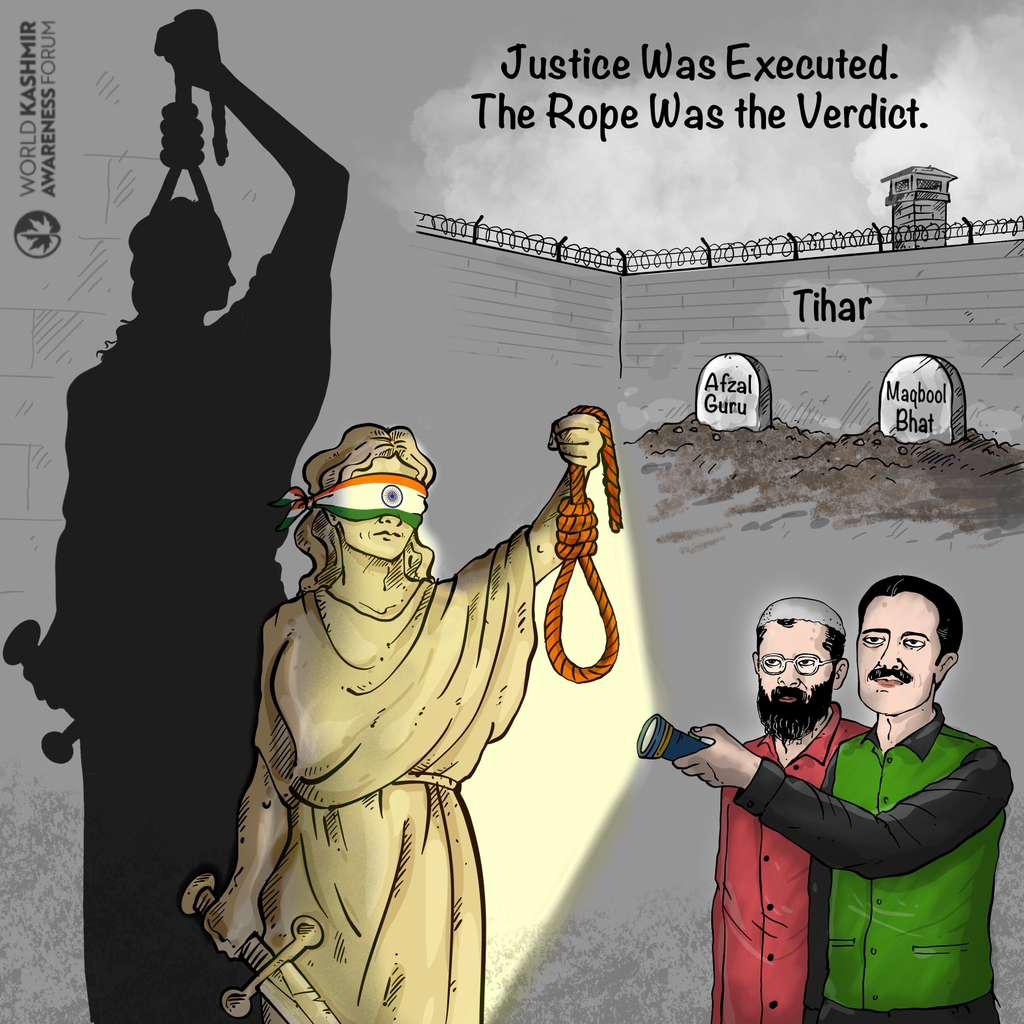
Their lynchings within Tihar Jail added to a tradition of alienation between Kashmir and New Delhi.
Maqbool Bhat and Afzal Guru’s executions are not being recalled as some ordinary criminal justice practices in Kashmir. They are recalled as political utterances — instances where the voice of the state prevailed over the cry of a nation.
The two were interred in the same prison. Neither of them was even given an opportunity to see their families in any substantive way. Neither had they been allowed the land of their own.
This is not considered a coincidence in Kashmir. It is seen as a pattern.
Maqbool Bhat; The Man Who Refused to Be Peripheral
Maqbool Bhat became a contemporary of the times that the political future of Kashmir was hanging between promises and betrayals. Maqbool Bhat was not just a political activist, but one of the first organized voices that demanded that Kashmiris choose their own political future. Being one of the founders of Jammu and Kashmir Liberation Front (JKLF) he formulated a vision of an autonomous Kashmir, neither Indian nor Pakistani but self-governing.
He was a revolutionary to many people in Kashmir who had been influenced by a war that was not their fault. Bhat had a sentence to death row after being arrested, tried, and sentenced. His many years of death row stay were not just a court case but a crippling of a political wrangle that had never reached a solution. In February 1984 he was executed after an Indian diplomat was assassinated in a foreign country by people who wanted him to be released. The political climate in the world was volatile. The state acted in a decisive manner.
His hanging on February 11, 1984, followed an increased political tension. There was a common belief among Kashmiris that the move to execute the death sentence was a political decision of that time and not necessarily caused by the law of inevitability.
He was hanged and buried inside Tihar.
Since then, February 11 has no longer been a date, but a memory rite. The cry to give back his body has echoed forty years. The absence of Bhat became a presence in Kashmir.
Afzal Guru ; The Trial That Echoed a Nation
Almost 30 years later, Kashmir saw another of its sons being headed towards the gallows.
Afzal Guru was a prime suspect in the 2001 Indian Parliament attack — an attack that rocked India and heightened the tension with its neighbor Pakistan. The trial was done under extra national pressure. The Supreme Court of India supported his conviction. Although the Supreme Court of India ruled in favor of the death sentence, law professors and civil liberties activists questioned the issue of representation, procedure and the standard of evidence in death cases. The court, in its ruling, appealed to an expression, which would sound well beyond the legal community: the execution was warranted to “appease the collective conscience of society”.
That wording to most Kashmiris proved their greatest fear: that Afzal Guru had not been executed due to legal reasons but it was a symbolic gesture to a nation that was outraged and a message to those who dared to resist. He was hanged on February 9, 2013 in Tihar Jail.
His family in Kashmir were reportedly notified by the authorities only after the execution had been done. There was no final meeting. No last embrace. No chance of a mother to look into the eyes of her son one last time.
He was also buried inside the prison like Bhat. Kashmir was once again denied a grave in history.
The past did not reoccur without noise. It was repeated nearly in the same way.
The Phrase That Haunts: “Collective Conscience” vs Due Process
The expression “collective conscience” has a jurisprudential pedigree. In Kashmir it means something different. The law in conflict areas seldom seems to be impartial. By mentioning societal outrage, the already marginalized communities might feel that they are not a part of that society. Kashmiris query: whose conscience is being gratified? Was it theirs?
To most Kashmiris, the invocation was less a legal norm, a certain call, that the execution would be a consolation to a nation that was hurt.
The image that the execution of Afzal Guru was more of a national political story, instead of legal proportion, further increased the lack of trust between the Kashmir and Indian institutions. To many, it affirms the belief that Kashmiri lives are tangled in a system that assumes guilt precedes innocence and in the minds of the Kashmiris, collective conscience is shorthand for something else: that verdicts in political cases are never solely of a legal nature.
Secrecy of Executions: Denial of the Final Meeting
Execution is irreversible. But it is also ritualized. It has protocols, appeals, mercy petitions, last meals, final meetings. These ceremonies are supposed to save, at least theoretically, a piece of humanity in punishment.
The families in the two instances were not given a timely notification. In the case of Guru, his relatives have reported that they were informed officially after the execution had occurred. The meeting before death is not symbolic but psychological. It enables grief to set to work its gradual change from shock to mourning. In its absence, death is suddenly shocking, rough, crudely incomplete. The refusal of the farewell was a wound to the families in Kashmir.
Burial Inside Tihar Jail: Why This Matters
The grave that can never be visited is the more powerful one than the grave that can. Tihar Jail turned out not only to be a place of imprisonment, but also of the graveyard of the two heroes of Kashmir.
The authorities gave the reason of security by claiming that burying on prison grounds would be a better place since bringing the bodies back might create unrest. However, in the Kashmir region, this verdict can be regarded as collective punishment —an effort to deprive society of the opportunity to grieve and avoid symbolic mobilization. Kashmiri funerals are not just ceremonies but they are group identity statements. Cemeteries in Kashmir are not resting places as such, but archives. Sculpted in stone are names that mark decades of struggle.
The absence of their graves is celebrated in the form of shutdowns, demonstrations, poetry and graffiti. The 11th and 9th of February are not merely anniversaries of death, but triggers of an even deeper political scorecard.
Grief Without a Grave: The Kashmiri Experience
Respect of the dead and rights of the families to recover bodies are the international humanitarian norms and burial rituals are considered to be holy practices that are conducted immediately in the Islamic tradition after death.
Withholding the remains, in addition to making punishment, the state of India has caused disruption of spiritual continuity. This denies dignity in the moral vocabulary of Kashmir.
The echoed question is straightforward: How dangerous can a corpse be?
The Indian state can exercise territorial control. It may control prisons. It can manage burial sites but it is powerless to control the memory of the people.
Bhat and Guru are buried in Tihar but their names spread fiercely in Kashmir like never before. Their images are seen in the walls. Their tales are told within the homes as a part of lived-in history. They have not been suppressed away. The brutality of the Indian Government has elevated their names.
The Paradox of Containment
Both cases have an irony attached to them. Authorities tried to suppress the reaction by interring the men within prison walls. But containment rarely kills memory. Quite the contrary, it amplifies absence. The restless body would have been buried, grieved and slowly sunk into the landscape.
It developed as a blend of government response, citizen attitude and a tale of a generation. The fact that they were executed in secrecy, the fact that their bodies are not given back, enhanced their status. The thing that could have stayed within the records of the courts was ingrained in people. The fact that there was no grave in Kashmir, worked against them and made them more present in its political imagination.
In Kashmir, Bhat and Guru are being remembered not only in terms of what they did or what they were supposed to have done, but also in terms of how they were buried.
The Unfinished Sentence
Sentences end with executions but at dawn in Tihar Jail the tale was not finished. It lingers still in yearly commemorations, in disputed histories, in unrewarded prayers on the part of mothers.
In the years since the execution of Maqbool Bhat and Afzal Guru, the relatives of the executed have continued to demand the simplest right: taking back the remains of their relatives. This has been despite the movement of time and the rise of new administrations as the same demand continues to be made, and new generations have grown up, nevertheless, the demand is still there. To the people who are closest to the deceased, the years may not take away the lack of a burial site to visit and the soil to feel, thus creating a permanent gap.
The general Kashmiri question persists silently: why deny a final farewell? The drive of the demand has outgrown legal reasoning and politics, it is now all about the necessity of closure. The rites of funeral ceremonies enable mourning to receive a sort of closure and burial brings back the memory to a particular space. Without such practices, mourning will always be in an unfinished, undecided position.
As justice includes verdicts, procedural mechanics and sentences. It, nevertheless, has a moral aspect as well. The way dignity is upheld despite the punitive action taken to the living is indicative about the moral sense of the living. The handling of the dead is therefore a very valid gauge on the conscience of a given society.